
You didn't inherit a league. You inherited a box.
■
Governance, compliance and continuity for the volunteer boards that run youth sports. Your registration platform handles the games. Nobody handles the organization — and that's where leagues actually fail.
Free, no call required. Fifty questions across ten domains.
[ The problem ]■
The thing nobody tells you when you're elected
Your league is not a sports organization.
It's a small nonprofit corporation. Six-figure budget. Other people's children in its custody. Contracts, real property, tax filings, insurance, a legal duty of care. And a leadership team that turns over completely every year with no training and no handoff.
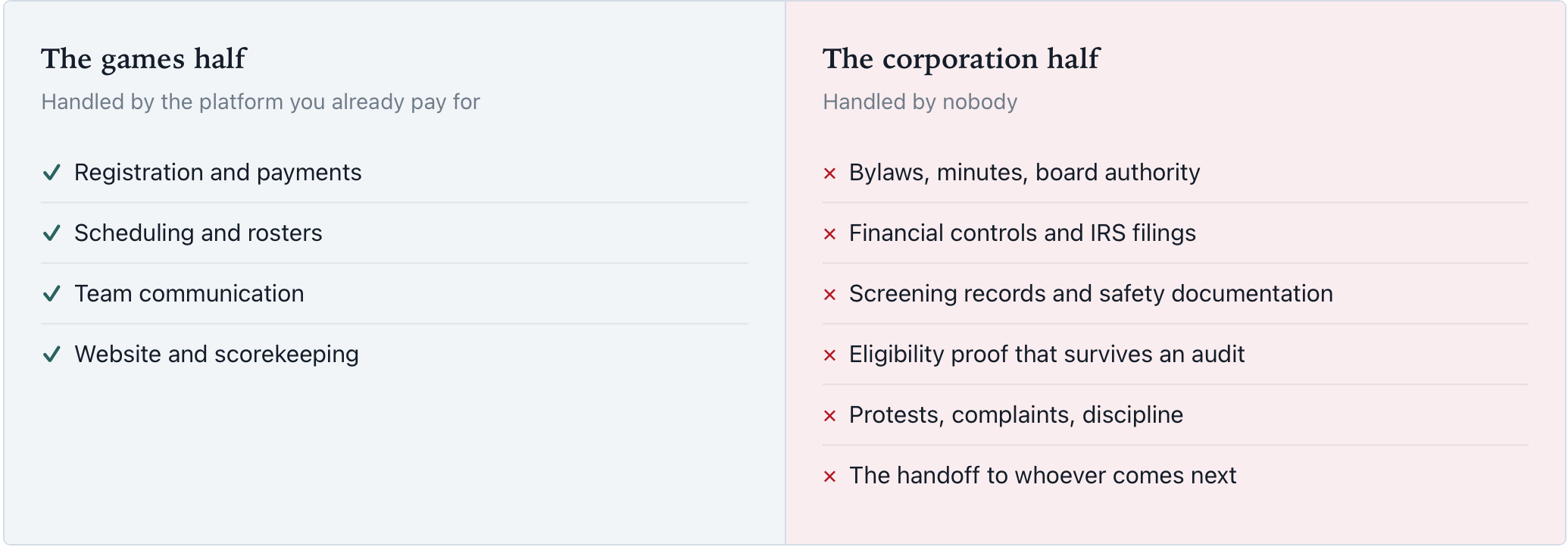
Leagues almost never fail at scheduling. They fail when the treasurer leaves and nobody has bank access. When a background check was skipped. When the field agreement lapses. When a protest is filed and the president has never read the protest rule. When an all-star team is disqualified in July for a residency form that was wrong in February.
Every one of those is preventable. Every one is a paperwork failure. And every one happens because the person who knew is gone.
[ the framework ] The League Operating System
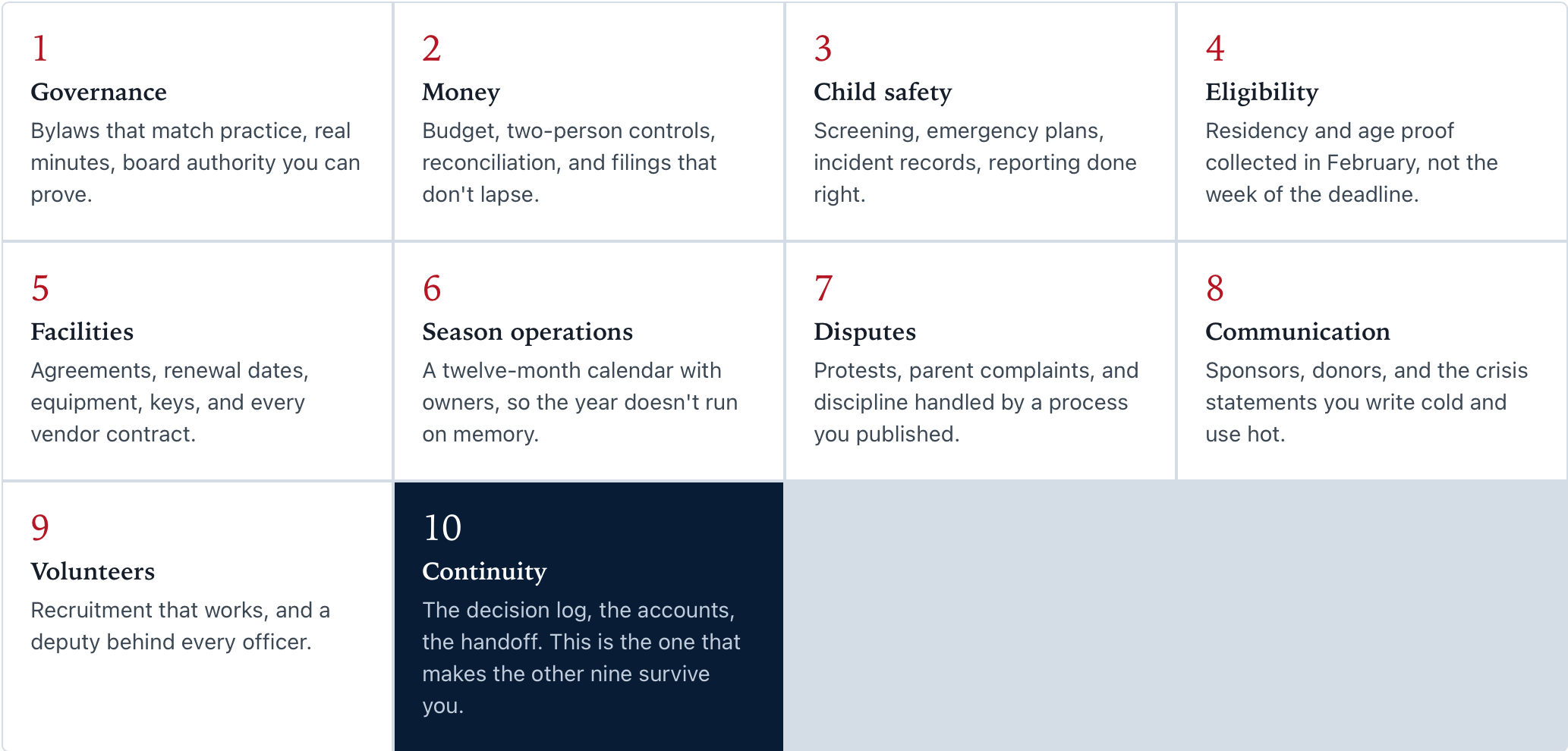
Ten domains. One of them decides the other nine.
Everything a volunteer board is actually responsible for, organized so you can see what you have and what you're missing.
Every domain scores on the same four levels

Most volunteer leagues score 1 or 2 in nine of ten domains, and have never thought about the tenth at all.
Our Founder
■
Chris Carey
Seasoned board member with experience serving on economic development corporation boards as well as youth baseball and softball boards. His leadership work centers on governance, organizational clarity, and building sustainable volunteer-driven systems.
In youth sports, Carey has played a significant role in player development and team formation, helping guide teams and leagues with an emphasis on consistency, preparation, and long-term growth. Under his leadership, Boerne Little League advanced to the Little League World Series U.S. Championship game in 2024 and to the Southwest Representative to the LLWS in 2026—an accomplishment reflecting strong organizational culture and collective effort rather than individual recognition.
Carey’s perspective on leadership is shaped by hands-on service in community organizations where success is often measured quietly and sustainability matters more than visibility. This book draws from those experiences to explore the realities of volunteer leadership in youth sports, focusing on decision-making, trust, and the human side of running organizations built on shared commitment.
He lives in Texas with his family and continues to serve in leadership roles dedicated to community development and youth engagement.
[ the flagship ]The Relay Throw
A relay throw isn’t one player making a heroic throw from the warning track. It’s two players, positioned deliberately, executing a handoff at speed - and the runner is out because someone was standing in the right place before the ball was hit.
Institutional memory works the same way. The handoff can’t be improvised at the moment of transition. It has to be built all season, before anyone needs it. The Relay Throw is the system that does it: a decision log that records why and not just what, an account register so the organization owns its own logins, an obligation calendar, officer handoff packets, and a structured transition meeting.
The test it’s built around: if every current office disappeared tonight, could a new board run a full season from the written record without contacting any of them?
[ pricing ]"<insert message"
[ FAQ ]Questions boards actually ask
-
No, and you should keep them. Those handle your games: registration, schedules, rosters. This handles your organization: bylaws, financial controls, safety documentation, disputes, and the handoff. Different problem, different tool. They don't overlap.
-
The assessment is free and the Officer Pack is $79. But name the comparison out loud: your league spends more on umpires in one weekend than the Binder costs for a year. This is priced as insurance, not software.
-
You can, and some of it you should — every league is a little different. The real questions are whether you'll do it before the season starts, and whether you'll update it when the rules change next year. And no template tells you what to do when a protest is filed at 9pm on a Saturday.
-
Then you're ahead of most leagues. Two questions: when were those last updated, and does the folder cover continuity — decision logs, account transfer, handoff packets? That's where almost every shared folder stops.
-
That's exactly the argument for it. The whole system is built for the person who's leaving. The only question is what you hand the next one.
-
No. It's operational guidance and document templates from someone who ran a league. Anything with legal exposure carries a note to review it with your own counsel, and requirements vary by state and by governing body.
-
Nine of the ten domains are identical in every sport — governance, money, safety, facilities, volunteers, communication, continuity. Only eligibility rules and the competition rulebook change. About 85% is sport-agnostic today.
[ ADDITIONAL INFORMATION ]